


Is estate planning just another name for making a will? Not quite.
At Brooks Wills, we see estate planning as organising your wealth and wider affairs so they can pass to future generations as efficiently and appropriately as possible, while also making sure the right people can act for you during your lifetime if you need support.
That word efficiently does not simply mean paying less tax. It can also mean making your wishes clear, checking how assets are owned, reducing avoidable complications, keeping nominations up to date and making sure the documents you have actually work together.
One of the most common gaps is straightforward: somebody makes a will and assumes the planning is finished, but overlooks Lasting Powers of Attorney. A will deals with what happens after death. It does not give somebody authority to manage your money, property, health or welfare decisions while you are alive.
This guide explains what estate planning can include in England and Wales, when a simple plan may be enough, where LPAs fit in and what to review if you already have a will.
What does estate planning actually mean?
Estate planning is the process of looking at your wealth, family circumstances and future wishes as one connected picture.
For many people, the aim is to organise matters so that wealth can pass to the people they choose in a clear and efficient way, while preserving enough control and flexibility during their own lifetime.
Depending on your circumstances, that may mean considering:
- who should inherit under your will;
- who should administer your estate;
- who should be able to make decisions for you during your lifetime;
- how your home and other jointly owned assets are held;
- whether pension, life assurance and death-benefit nominations are up to date;
- whether Inheritance Tax or other tax considerations are relevant;
- whether trusts genuinely solve a planning need;
- how business or agricultural interests fit into the wider plan; and
- where important documents and information can be found.
Estate planning is therefore less about collecting documents and more about making sure the different parts of your arrangements point in the same direction.
Is estate planning the same as making a will?
No. A will is central to many estate plans, but it only does part of the job.
A valid will lets you set out who should benefit from your estate and who should deal with it after your death. If you die without a valid will, the intestacy rules determine who inherits the estate that falls within those rules.
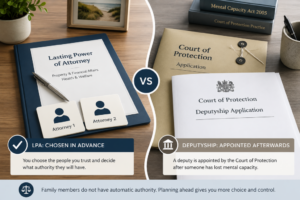
But a will does not give anybody authority to make decisions for you while you are alive. That is where Lasting Powers of Attorney can become important.
This is the distinction we think is often missed: a will is mainly about what happens after death; LPAs are about who can act during your lifetime if needed.
The estate-planning gap people often overlook: LPAs
Many people feel they have dealt with their future planning once a will is in place. In practice, that can leave an important gap.
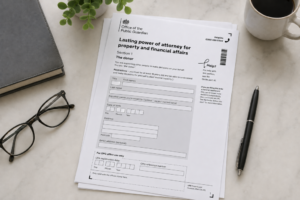
A Lasting Power of Attorney (LPA) allows you, while you have the required mental capacity, to appoint people you trust as your attorneys. There are two types in England and Wales:
- Property and Financial Affairs LPA – covering decisions about matters such as bank accounts, bills, pensions, investments and property.
- Health and Welfare LPA – covering decisions about matters such as care, medical treatment and where you live when you are unable to make those decisions yourself.
Family members do not automatically gain legal authority to make all of these decisions simply because they are a spouse, partner, adult child or close relative.
An LPA must be registered with the Office of the Public Guardian before it can be used. The right approach depends on your circumstances, and not everybody will need exactly the same arrangements.
Read more about Lasting Powers of Attorney.
What might a straightforward estate plan include?
Not every estate needs trusts, complicated tax structures or multiple advisers. For many people, a sensible starting point is much simpler.
A straightforward plan may involve:
- a valid, up-to-date will;
- carefully chosen executors and replacement executors;
- considering both types of LPA;
- checking how property and other joint assets are owned;
- reviewing pension, insurance and death-benefit nominations;
- keeping practical information and important documents organised; and
- reviewing the plan after major life or financial changes.
More complex circumstances may justify additional advice, for example where there are business interests, overseas assets, farming assets, significant tax considerations, trusts, a blended family or a beneficiary who needs ongoing support.
How property ownership can affect the plan
How a jointly owned property is held can affect what happens on death.
In England and Wales, joint owners may hold property as joint tenants or tenants in common. With a joint tenancy, the deceased owner’s interest normally passes automatically to the surviving joint owner. With a tenancy in common, the deceased owner’s share can pass under their will or the intestacy rules.
That means a will cannot always redirect an asset in the way somebody assumes. Property ownership should be checked rather than guessed at, particularly before changing a will or making wider inheritance plans.
Changing ownership can have legal, tax, mortgage and later-life consequences, so individual advice may be appropriate before making changes.
What role does Inheritance Tax play?
Tax can be part of estate planning, but it should not become the whole definition of estate planning.
Inheritance Tax depends on matters including the value and make-up of the estate, who receives assets, lifetime gifts, trusts, reliefs and exemptions. The rules and thresholds can change.
Good planning should therefore be tax-aware where tax is relevant, but it should also consider your own financial security, access to assets and the practical effect of any arrangement during your lifetime.
Estate planning should not be sold as a way to guarantee that tax, probate or future care costs can be avoided.
What about planning for later-life care costs?
Planning for later-life care costs may form part of a wider review, particularly where property, savings, income and future decision-making need to be considered together.
Outcomes depend on individual circumstances and the rules applying at the relevant time. No arrangement can guarantee that assets will be protected or that care fees will be avoided.
A balanced plan should keep your own wellbeing, financial security and control in view rather than focusing only on what may eventually pass to the next generation.
Do I need trusts as part of estate planning?
Not necessarily.
Trusts can be useful in some circumstances, for example where assets need to be managed for a beneficiary over time, there is a vulnerable beneficiary, or family circumstances call for additional control or flexibility.
But a trust should solve a genuine problem. Trusts can also bring administration, tax and reporting responsibilities. A simpler arrangement may be more appropriate where those additional features are not needed.
How much does estate planning cost?
There is no single estate-planning price because the work depends on what is actually needed.
Some people may only need a will review. Others may need a new will and both types of LPA. More complex family, trust or property circumstances may require additional work or input from another appropriately qualified professional.
Brooks Wills publishes its current professional fees openly, including will, LPA and package pricing, so you can understand likely costs before deciding whether to proceed. You can see the current figures on our Fees page.
When should you review your estate plan?
An estate plan should change when life changes.
It is sensible to review your arrangements after events such as:
- marriage, civil partnership, separation or divorce;
- the birth or adoption of children or grandchildren;
- a house move or change in property ownership;
- retirement;
- receiving an inheritance;
- starting, buying or selling a business;
- a significant change in health or care needs;
- an executor or attorney becoming unable or unsuitable to act;
- a major change in a beneficiary’s circumstances; or
- a significant change in tax or succession rules.
Even without a major event, a periodic review can help identify documents or nominations that no longer match your wishes.
A practical estate-planning check
If you already have a will, start by asking a broader question: does everything around the will still work?
- Is your will current and valid?
- Are your chosen executors still appropriate?
- Have you considered both types of Lasting Power of Attorney?
- Do you know how jointly owned property is held?
- Are pension, insurance and death-benefit nominations current?
- Are there tax, business, farming or overseas issues that need specialist advice?
- Would any beneficiary need additional support or careful planning?
- Do trusted people know where important documents are kept?
- Does your plan still reflect what you want to achieve for future generations?
Estate planning in Poole, Bournemouth and Christchurch
Brooks Wills helps individuals and families across Poole, Bournemouth, Christchurch and wider Dorset look at wills, Lasting Powers of Attorney and wider estate-planning arrangements together rather than in isolation.
Our approach is to explain the options clearly, identify gaps and help you understand the next sensible step. Where tax, investment, complex property or other specialist advice is needed, it may be appropriate for estate planning to involve more than one professional.
Brooks Wills is a member of the Institute of Professional Willwriters and the Society of Will Writers.
If you have made a will but have not reviewed your wider arrangements, that is a useful place to start. Call, message or book a consultation to discuss what you already have in place and what may need attention.
Simplifying legacies, securing tomorrow.
This article provides general information for England and Wales. It is not individual legal, tax, financial or care-funding advice. Appropriate arrangements and outcomes depend on individual circumstances.
Frequently asked questions
What is the main purpose of estate planning?
Estate planning is about organising your wealth and wider affairs so they can be dealt with in line with your wishes, both during your lifetime and after your death. For many people, that includes helping wealth pass to future generations in a clear and efficient way.
Is a will enough for estate planning?
Sometimes a person’s needs are straightforward, but a will only deals with part of the picture. It does not give somebody authority to manage your financial affairs or make health and welfare decisions for you during your lifetime. LPAs, property ownership and nominations may also need to be considered.
Why are LPAs part of estate planning?
LPAs let you choose trusted people to make certain decisions for you if needed. They address lifetime decision-making, whereas a will mainly deals with your estate after death.
Is estate planning only for wealthy families?
No. Complex tax planning may be relevant to some estates, but basic estate planning can also be useful for people who simply want a valid will, suitable LPAs, clear ownership arrangements and organised information for their family.
Does estate planning guarantee a lower Inheritance Tax bill?
No. Tax outcomes depend on individual circumstances and the law in force at the relevant time. Tax-efficient planning may be possible in some circumstances, but it should be properly advised and balanced against your own needs and financial security.
What should I do if I already have a will?
Check whether the rest of your arrangements still fit around it. In particular, consider LPAs, property ownership, pensions and nominations, executors, important documents and any major changes in your family or finances.