


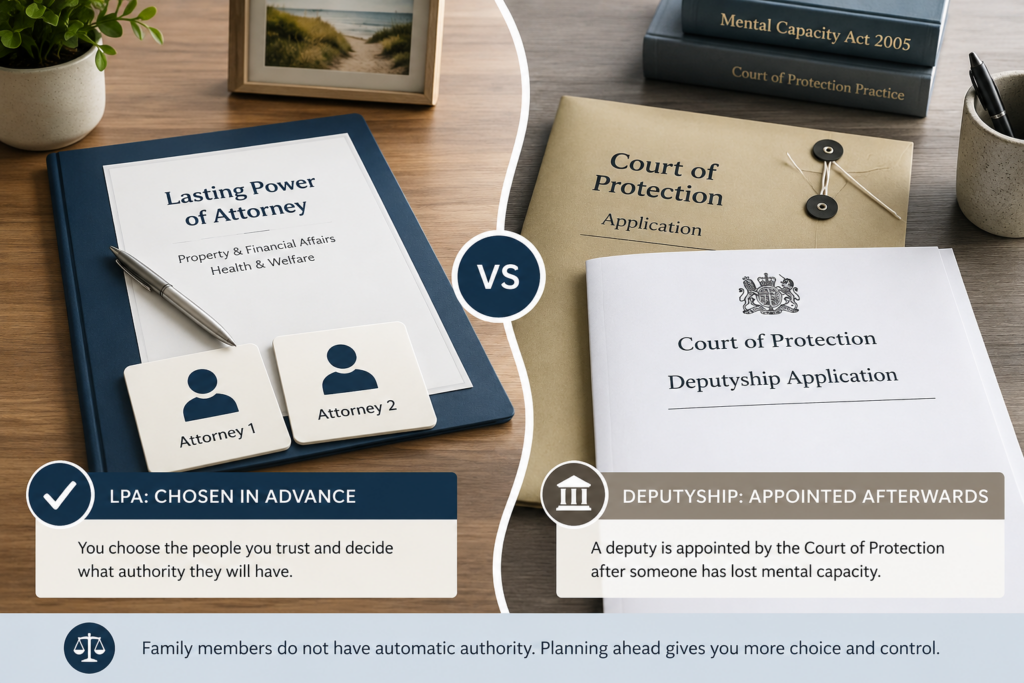
A Lasting Power of Attorney and a deputyship can both give someone legal authority to make decisions for another person.
But they arise at very different stages.
A Lasting Power of Attorney is made in advance, while you still have the mental capacity to choose who should act for you.
A deputy is appointed by the Court of Protection after a person has lost the mental capacity to make the relevant decisions and there is no suitable authority already in place.
For many families, this distinction only becomes important when a bank, care provider, hospital or other organisation asks a difficult but necessary question: who actually has legal authority to make this decision?
Understanding the difference beforehand can make planning much clearer.
LPA vs deputyship at a glance
| Lasting Power of Attorney | Deputyship | |
|---|---|---|
| When is it arranged? | While the donor has mental capacity | After the person lacks capacity for the relevant decisions |
| Who chooses the decision-maker? | The donor chooses their attorney or attorneys | The Court of Protection decides who should be appointed |
| Who gives the authority? | The donor, through the LPA | The Court of Protection, through a court order |
| Can wishes and instructions be included? | The donor can include appropriate preferences and instructions | The deputy’s authority is defined by the court order |
| Government application fee | £92 per LPA | £432 for a deputyship application |
| Ongoing supervision fee? | No routine annual supervision fee | Usually yes |
| Ongoing reporting? | Not routinely in the same way as a deputy | Deputies normally submit annual reports |
| Who supervises the arrangement? | The Office of the Public Guardian can investigate concerns | Deputies are supervised by the Office of the Public Guardian |
| Main purpose | Planning ahead | Providing authority after capacity has been lost |
Government fees shown are those applying in September 2026 and may change. Reductions or exemptions may be available in some circumstances. Professional fees, where applicable, are separate.
Which route applies to you?
For most people, the starting point is not really “LPA or deputyship?”
It is: does the person still have the mental capacity to make an LPA?
If you still have capacity and want to plan ahead
A Lasting Power of Attorney is normally the route to consider.
You can choose who you trust, decide how attorneys should act and put the authority in place before it is needed.
If capacity is uncertain
Do not assume that a diagnosis of dementia, a brain injury or another condition automatically prevents somebody from making an LPA.
Mental capacity is both decision-specific and time-specific.
The important question is whether the person can understand the nature and effect of making the LPA at the time they make it.
Where there is genuine uncertainty about capacity, appropriate professional input may be needed.
If the person has already lost the capacity needed to make an LPA
They cannot make a new LPA for that decision.
It may then be necessary to consider an existing LPA or Enduring Power of Attorney, deputyship, a one-off Court of Protection application or another more limited form of authority, depending on what actually needs to be done.
What is a Lasting Power of Attorney?
A Lasting Power of Attorney, usually shortened to LPA, is a legal document used in England and Wales.
It allows you, as the donor, to appoint one or more people you trust as your attorneys.
Those attorneys can then support you or make decisions for you within the authority provided by the LPA.
You must have mental capacity to make the LPA, and it must be registered with the Office of the Public Guardian before it can be used.
There are two types.
Property and Financial Affairs LPA
This can cover matters such as:
- bank and building society accounts;
- paying bills;
- pensions and benefits;
- investments;
- managing property; and
- selling property where the LPA gives the necessary authority.
Once registered, a Property and Financial Affairs LPA can be used while the donor still has capacity if the donor permits this.
Our Property and Financial Affairs LPA Explained guide looks at this in more detail.
Health and Welfare LPA
This can cover decisions about matters such as:
- care and support;
- where the donor lives;
- medical treatment;
- day-to-day welfare; and
- life-sustaining treatment where the LPA gives the attorney that authority.
A Health and Welfare LPA can only be used when the donor lacks capacity to make the particular decision themselves.
See our Health and Welfare LPA Explained guide for a fuller explanation.
What is deputyship?
A deputy is appointed by the Court of Protection to make specified decisions for someone who lacks mental capacity to make those decisions themselves.
The court decides:
- whether a deputy is needed;
- whether the proposed deputy is suitable;
- what decisions the deputy can make; and
- any limits or conditions that should apply.
The deputy’s authority comes from the court order, rather than from the person who has lost capacity.
This distinction matters.
A deputy should never assume that being appointed gives them unrestricted authority over everything in the person’s life.
What are the different types of deputyship?
There are two broad categories.
Property and financial affairs deputyship
This is the more common form.
A deputy may be authorised to deal with matters such as income, bills, savings, property and other financial affairs.
The exact authority depends on the order made by the Court of Protection.
Personal welfare deputyship
A personal welfare deputy may be given authority over particular health or welfare decisions.
However, personal welfare deputyships with broad continuing powers are not routinely appointed.
The Court of Protection will usually appoint a personal welfare deputy only where there is a particular reason for ongoing authority — for example, where there is disagreement about whether decisions will be made in the person’s best interests or where somebody needs authority over a specific issue over time.
In other cases, the court may make a decision about a particular issue instead of appointing a deputy with wide powers.
Why does an LPA usually give you more choice?
The most important practical advantage of making an LPA in advance is choice.
While you have capacity, you can decide:
- who you trust to act;
- whether you want one attorney or several;
- how multiple attorneys should make decisions;
- who should act as a replacement if an attorney can no longer continue;
- whether suitable preferences should be recorded; and
- whether appropriate binding instructions should be included.
With deputyship, the person who lacks capacity can no longer create that arrangement for themselves.
Someone else applies to the Court of Protection, and the court decides whether the proposed appointment is suitable.
That does not make deputyship a “bad” arrangement. It can provide essential authority when no other suitable authority exists.
It simply serves a different purpose.
How much does an LPA cost compared with deputyship?
Cost is one of the most practical differences between the two routes.
LPA registration fees
As at September 2026, the Office of the Public Guardian charges:
- £92 to register one LPA
- £184 to register both a Property and Financial Affairs LPA and a Health and Welfare LPA
Some donors may qualify for a reduction or exemption based on their financial circumstances.
These are government registration fees only. Any professional fees for help preparing an LPA are separate.
Deputyship fees
As at September 2026, the government charges a £432 application fee for a deputyship application.
Other costs can also arise.
Depending on the circumstances, these may include:
- £266 if the court requires a hearing;
- a security bond for some property and financial affairs deputies;
- a £100 deputy assessment fee after appointment;
- an annual Office of the Public Guardian supervision fee, normally £320 for general supervision; or
- £35 for minimal supervision where the qualifying conditions apply.
If applications are made for both types of deputyship, further application fees can apply.
Reductions or exemptions may be available in some circumstances.
Professional fees for assistance with a Court of Protection application are additional where professional help is used.
Because deputyship involves a court process and continuing supervision, the overall cost can therefore be considerably greater than putting an LPA in place in advance.
What about timescales?
An LPA is not effective the moment the form is signed.
It needs to be completed correctly and registered with the Office of the Public Guardian.
Current government guidance says registration normally takes around 8 to 10 weeks if there are no mistakes in the application.
That is one reason an LPA works best as advance planning rather than something left until a crisis.
Deputyship involves a Court of Protection application, evidence concerning mental capacity and consideration by the court.
There may also be notification requirements, requests for additional information, objections, a security bond or a hearing.
The precise timescale therefore depends on the circumstances and the complexity of the application.
Where an urgent decision genuinely cannot wait for the normal court process, separate urgent or interim Court of Protection procedures may sometimes need to be considered.
Can your spouse or children automatically act for you?
No.
Being someone’s husband, wife, civil partner, partner, son or daughter does not automatically give you legal authority to:
- operate their bank accounts;
- manage their investments;
- sell their property;
- sign documents for them; or
- make all health and welfare decisions on their behalf.
Legal authority has to come from somewhere.
That could be a valid LPA, an Enduring Power of Attorney, a Court of Protection order or another form of authority that applies to the particular issue.
Our guide Why Your Children Can’t Automatically Make Decisions for You explains this in more detail.
What happens if someone has dementia?
A dementia diagnosis does not automatically mean that somebody cannot make an LPA.
The law does not treat capacity as an all-or-nothing label.
A person may be unable to make one particular decision but still be able to make another.
Their ability may also fluctuate.
The relevant question is whether they can understand and make the particular decision about creating the LPA at the time it needs to be made.
This is why it is important not to jump immediately from “there is a diagnosis” to “it is too late for an LPA”.
Equally, an LPA should not be created where the donor does not have the capacity required to understand it.
Where the position is uncertain, capacity should be considered carefully.
Do you always need deputyship if someone has lost capacity without an LPA?
No.
This is an important distinction.
Deputyship may be appropriate where ongoing authority is genuinely needed, particularly for property and financial affairs.
But it is not necessarily the answer to every situation.
For example:
- there may already be a valid LPA or Enduring Power of Attorney;
- a benefits appointeeship may be sufficient if the only issue is managing certain benefits;
- the Court of Protection may be asked to make a specific one-off decision rather than appointing a deputy; or
- another limited legal arrangement may deal with the particular issue.
The right starting point is therefore to identify what decision actually needs to be made and what existing authority, if any, already exists.
Can someone have both an LPA and a deputy?
Yes.
For example, somebody might have a valid Health and Welfare LPA but no Property and Financial Affairs LPA.
If they later lose capacity to manage their finances, a property and financial affairs deputyship might need to be considered.
There may also be situations where an existing LPA does not give the attorney authority for a particular matter and the Court of Protection becomes involved.
Whenever more than one form of authority exists, the precise wording of the LPA and any court order needs to be checked.
What responsibilities do attorneys and deputies have?
Neither an attorney nor a deputy is simply given permission to do whatever they think is best.
Both roles carry important responsibilities under the Mental Capacity Act 2005.
Among other things, decision-makers must recognise that:
- a person should be assumed to have capacity unless it is established otherwise;
- reasonable steps should be taken to support the person to make their own decisions;
- making an unwise decision does not by itself mean someone lacks capacity;
- decisions made for a person who lacks capacity must be in their best interests; and
- the option chosen should interfere with the person’s rights and freedom as little as reasonably possible.
Attorneys and deputies must also remain within the limits of the authority they have been given.
Deputies are formally supervised by the Office of the Public Guardian and normally have annual reporting obligations.
Attorneys are not routinely supervised in the same way, although the Office of the Public Guardian can investigate concerns and the Court of Protection can intervene.
Can making an LPA prevent the need for deputyship later?
A properly prepared and registered LPA can often avoid the need for somebody to apply for deputyship in relation to decisions already covered by that LPA.
That is one of the practical reasons people choose to make LPAs while they are able to do so.
But it is important not to overstate this.
An LPA does not guarantee that the Court of Protection will never be involved.
A court application may still become necessary where, for example:
- the required decision falls outside the attorney’s authority;
- there is a dispute;
- an attorney can no longer act and there is no effective replacement;
- there are safeguarding concerns; or
- the court’s specific authority is required.
The benefit of an LPA is that it allows you to make many important decisions about who you want to act and how you want the arrangement structured before capacity becomes an issue.
So which is better: LPA or deputyship?
They are not really competing products.
They solve problems at different times.
If you have mental capacity and want to decide who could act for you in future, an LPA gives you the opportunity to plan ahead and retain more control over that choice.
If the relevant capacity has already been lost and no suitable authority is in place, deputyship may provide a route for somebody to obtain the legal authority that is now required.
The key difference can be summed up simply:
An LPA allows you to choose in advance. Deputyship asks the court to decide afterwards.
LPA and deputyship guidance in Poole, Bournemouth and Christchurch
Brooks Wills provides clear, plain-English guidance on Lasting Powers of Attorney and later-life planning for individuals and families across Poole, Bournemouth, Christchurch and wider Dorset.
If you are still able to make your own decisions and want to plan ahead, read about our Lasting Powers of Attorney services.
If you are helping someone who may already have lost capacity, see our Deputyship and Court of Protection guidance.
And if you are not sure which situation applies, you can call, message or book a consultation to talk through the appropriate next step.
Brooks Wills is a member of the Institute of Professional Willwriters and the Society of Will Writers.
Simplifying legacies, securing tomorrow.
This article provides general information for England and Wales and is not individual legal advice. Mental capacity and the appropriate form of authority depend on the individual circumstances. Government fees quoted were checked in September 2026 and may change.
Frequently asked questions
Is a deputy the same as an LPA attorney?
No. An attorney is chosen by the donor through a Lasting Power of Attorney while the donor has mental capacity to make it. A deputy is appointed by the Court of Protection after the person lacks capacity for the relevant decisions.
Can I make an LPA after being diagnosed with dementia?
Potentially, yes. A diagnosis of dementia does not automatically mean somebody lacks the mental capacity to make an LPA. The question is whether they can understand the nature and effect of making the LPA at the relevant time.
What happens if someone has already lost capacity without an LPA?
First establish what decisions need to be made and whether any existing legal authority covers them. Depending on the circumstances, it may then be necessary to consider deputyship, a one-off Court of Protection order or another more limited arrangement.
Is deputyship more expensive than an LPA?
It generally involves more potential fees and ongoing administration. As at September 2026, registering one LPA costs £92 in government fees. A deputyship application costs £432, with additional costs potentially arising for hearings, assessment, security bonds and ongoing supervision. Individual circumstances differ, and professional fees may also apply.
Does the Court of Protection automatically appoint a family member?
No. The court considers whether the proposed deputy is suitable and whether the appointment is appropriate. Depending on the circumstances, a family member, another suitable individual, a professional or a panel deputy may be appointed.
Can a deputy make health and welfare decisions?
Only where the Court of Protection gives the deputy that authority. The court does not routinely appoint personal welfare deputies with broad powers. In some cases it may make a decision about a specific issue instead.
Can an LPA completely avoid the Court of Protection?
Not necessarily. A valid LPA may avoid the need for deputyship for decisions covered by it, but the Court of Protection can still become involved where a matter falls outside the attorney’s authority, a dispute arises or another court decision is required.