


Making a will is one of the clearest ways to record what should happen to your money, property and possessions after your death.
A well-prepared will can also appoint the people who should deal with your estate, name guardians for children under 18 and explain what should happen if a beneficiary dies before you.
However, a will is only effective if it is suitable for your circumstances and signed correctly. Property ownership, pensions, trusts, family relationships and lifetime planning can all affect how the overall plan works.
This complete guide explains the main decisions involved in making a will in England and Wales, the formal requirements, common mistakes and the circumstances in which tailored guidance is particularly important.
What is a will?
A will is a legal document that records how you want your estate to be dealt with after your death.
Your estate usually includes the assets you own in your sole name, less any debts and liabilities. It may include:
- your home and other property;
- bank and building society accounts;
- savings and investments;
- business interests;
- vehicles;
- jewellery and personal possessions;
- digital assets; and
- money owed to you.
Not every asset necessarily passes under the will. Jointly owned property, some pensions, life assurance policies and assets held in trust may pass under different arrangements.
Why is making a will important?
A will allows you to make choices rather than leaving the distribution of your estate to the intestacy rules.
It can help you:
- choose who should inherit;
- appoint executors;
- name guardians for children under 18;
- provide for a spouse, partner, children or other dependants;
- leave gifts to friends or charities;
- make arrangements for a blended family;
- create trusts where appropriate;
- set out substitute beneficiaries; and
- record funeral wishes.
A clear will cannot guarantee that estate administration will be quick or prevent every disagreement. It can, however, reduce avoidable uncertainty and provide a much clearer starting point for the people dealing with your affairs.
What happens if you die without a will?
If you die without a valid will, you are said to die intestate.
The intestacy rules decide who inherits. The result may not reflect your wishes or family circumstances.
For example:
- an unmarried partner does not automatically inherit under the intestacy rules;
- stepchildren do not automatically inherit unless they have been legally adopted;
- friends and charities will not receive anything unless separately provided for;
- the person you would have chosen to administer the estate may not be the person entitled to apply; and
- the estate may be divided in a way you would not have chosen.
Read our detailed guide to what happens if you die without a will.
Who can make a will?
In England and Wales, a person must generally be aged 18 or over and have the required mental capacity to make a will.
The person making the will needs to understand broadly:
- that they are making a will and what it will do;
- the general extent of their property and assets;
- the people who may reasonably expect to be considered; and
- the effect of the choices being made.
Capacity can be a sensitive issue where somebody has a diagnosis, memory difficulties or a fluctuating condition. A diagnosis does not automatically mean that a person cannot make a will. The question is whether they have the necessary understanding at the time the will is made.
Where capacity may later be questioned, careful records and appropriate professional or medical input may be important.
What should a will include?
Every will is different, but the main sections commonly include:
- identification of the person making the will;
- revocation of earlier wills;
- appointment of executors and replacement executors;
- guardianship appointments where relevant;
- specific gifts of money or possessions;
- gifts to charities;
- instructions about the residue of the estate;
- substitute beneficiaries;
- trust provisions where needed;
- administrative powers for executors and trustees; and
- the signature and witnessing section.
The wording should be clear enough to be applied after death, including where circumstances have changed or a beneficiary has died first.
Step 1: List your assets and liabilities
You do not normally need to list every asset inside the will itself, but preparing an overview helps you understand what you own and how it may pass.
Consider:
- property and land;
- bank accounts;
- investments and savings;
- pensions and death benefits;
- life assurance;
- business interests;
- valuable possessions;
- digital assets;
- mortgages, loans and other debts; and
- assets held jointly with somebody else.
Approximate values can help identify whether tax, trusts or specialist advice may be relevant.
Step 2: Check how your property is owned
Property ownership can affect whether a share of a home passes under the will.
Joint tenants
Where property is owned as joint tenants, the deceased owner’s interest normally passes automatically to the surviving joint owner. It does not usually pass under the will.
Tenants in common
Where property is owned as tenants in common, each owner has a distinct share. That share can normally pass under their will or the intestacy rules.
Do not assume how a property is owned. The title and any relevant declaration or restriction should be checked.
Changing the form of ownership can have significant consequences and should not be done without understanding the wider legal, tax, mortgage, family and later-life implications.
Step 3: Choose your executors
Executors are the people responsible for dealing with your estate after your death.
Their work may include:
- locating the original will;
- identifying assets and debts;
- valuing the estate;
- dealing with tax and reporting requirements;
- applying for probate where required;
- collecting or transferring assets;
- paying liabilities and expenses;
- keeping estate accounts; and
- distributing the estate to the beneficiaries.
Choose people who are trustworthy, organised and willing to act. Location, family relationships, age, health and the complexity of the estate may all be relevant.
You can appoint more than one executor and name replacements in case an original executor cannot act.
Read our guide to choosing executors.
Step 4: Decide who should benefit
Beneficiaries can include:
- a spouse or civil partner;
- an unmarried partner;
- children and grandchildren;
- stepchildren;
- other relatives;
- friends;
- charities; and
- other organisations.
Identify beneficiaries clearly. Names, relationships and substitute arrangements can help reduce uncertainty.
Consider what should happen if a beneficiary dies before you. For example, should their gift pass to their children, to another named person or back into the remainder of the estate?
Step 5: Decide how to divide the estate
There are several common ways to leave assets.
Specific gifts
A specific gift leaves a particular item or asset, such as jewellery, a vehicle or a named investment.
Think about what should happen if you no longer own that item when you die.
Cash gifts
A cash gift leaves a fixed amount of money.
Inflation and changes in the size of the estate may affect whether the amount remains appropriate over time.
The residue
The residue is what remains after debts, expenses, tax and specific gifts have been dealt with.
A well-drafted will should clearly state who receives the residue and what happens if a residuary beneficiary dies before you.
Percentage shares
Dividing the residue into percentages or shares can allow gifts to adjust automatically with changes in the value of the estate.
Step 6: Consider guardians for children
A parent with parental responsibility may use a will to appoint a guardian for a child under 18.
The appointment does not necessarily take effect immediately in every situation. Its effect can depend on whether another person with parental responsibility survives and the family circumstances at the time.
Before naming a guardian, consider:
- whether the person is willing to act;
- their relationship with the child;
- where they live;
- their age, health and family commitments;
- the child’s education, culture and religious background; and
- how funds would be managed for the child.
A guardianship appointment and financial provision for the child should be considered together.
Step 7: Consider trusts
A trust may be included where assets need to be managed by trustees for one or more beneficiaries.
Trusts may sometimes be suitable where:
- a beneficiary is under 18;
- a beneficiary has a disability or needs ongoing support;
- there is a blended family;
- somebody should benefit during their lifetime before assets pass elsewhere;
- a beneficiary may not be ready to manage a large inheritance; or
- flexibility is needed because future circumstances are uncertain.
Trusts are not automatically appropriate. They can create ongoing responsibilities, costs, tax considerations and reporting requirements.
The trustees should be suitable for the role, and the terms of the trust should reflect a genuine planning need.
Step 8: Think carefully about blended families
Second marriages, later relationships and blended families often need more than a simple assumption that everything should pass to the surviving partner.
Questions may include:
- how to provide security for a spouse or partner;
- how to preserve an eventual inheritance for children from an earlier relationship;
- whether stepchildren are intended to benefit;
- how the home is owned;
- whether beneficiaries should inherit immediately or through a trust; and
- what should happen if relationships change after the will is made.
Our guide to mirror wills explains why similar wills for a couple do not bind the survivor to keep the same arrangements later.
Step 9: Consider unmarried partners
An unmarried partner does not automatically inherit under the intestacy rules, regardless of how long the couple have lived together.
A will is therefore particularly important where you want an unmarried partner to receive property, money or possessions.
Also consider:
- how the home is owned;
- whether there is a mortgage;
- pension and life assurance nominations;
- financial dependency;
- children from current or earlier relationships; and
- whether a trust or right to occupy may be appropriate.
Step 10: Review pensions and life assurance
Some pension benefits and life assurance proceeds may pass outside the will.
Providers may ask for an expression of wish or beneficiary nomination. The legal effect depends on the scheme or policy.
Review:
- which schemes and policies exist;
- the nominated beneficiaries;
- whether the nomination is still current;
- whether the policy is written in trust; and
- how the benefits fit with the overall estate plan.
Regulated pension, investment and financial advice should come from an appropriately authorised adviser.
Step 11: Consider business and overseas assets
Specialist advice may be important if you own:
- a company or shares in a private business;
- a partnership interest;
- commercial property;
- farming or agricultural assets;
- assets in another country; or
- a home or tax residence outside England and Wales.
Company documents, partnership agreements, foreign succession rules and tax arrangements may affect what the will can achieve.
More than one will may sometimes be considered for assets in different countries, but the documents must be coordinated carefully so that one does not accidentally revoke another.
Step 12: Consider digital assets
Digital assets and online accounts can form an important part of a modern estate.
Examples include:
- email accounts;
- cloud storage;
- social media;
- digital photographs;
- websites and domain names;
- online businesses;
- online payment accounts;
- cryptocurrency; and
- other digital investments or intellectual property.
Keep a secure record that helps executors identify important accounts. Do not put passwords directly into the will, as the will may eventually become a public document after probate.
Access rights, ownership and the provider’s terms should also be considered.
Can funeral wishes be included?
Yes. A will may record funeral wishes, such as a preference for burial or cremation.
These wishes are not normally legally binding. The practical arrangements may also need to be made before the will is located or read.
Discuss important wishes with family or executors and consider recording them separately as well.
Can you leave money to charity?
Yes. A will can leave a fixed amount, a particular asset or a share of the residue to a charity.
Identify the charity clearly, normally using its full name, registered charity number and address where appropriate.
Charitable gifts can have Inheritance Tax consequences. The effect depends on the estate and the proportion left to charity, so tax advice may be appropriate.
What are the signing and witnessing rules?
A will must be signed and witnessed correctly to be legally valid.
In general:
- You sign the will, intending it to take effect as your will.
- Two witnesses must both have a clear view of you signing, or of you acknowledging your signature.
- Each witness signs the same document in your presence.
The witnesses do not necessarily have to sign at the same time as each other, but you must have a clear view of each witness signing.
A beneficiary, or the spouse or civil partner of a beneficiary, should not act as a witness. The will itself may remain valid, but the gift to that witness or their spouse or civil partner may fail.
An executor can legally act as a witness if they are not also a beneficiary, but independent witnesses are usually preferable.
Do not sign until the correct witnesses are present and the signing process has been explained.
Can a will be signed electronically?
For ordinary wills in England and Wales, the established formal process involves signing a physical document in the presence of witnesses.
Temporary rules that permitted remote witnessing by video during the coronavirus period have ended. A will should now be executed using the normal in-person process unless specific legal advice confirms otherwise.
Where should the original will be stored?
The original signed will is important. A photocopy may not be sufficient if the original cannot be found.
Store it somewhere:
- secure from loss, fire or accidental damage;
- where it will not be altered or marked;
- accessible to the executors after death; and
- known to at least one trusted person.
Do not attach documents with staples or paperclips after signing, because marks or holes may raise questions about whether something was removed.
Tell your executors where the original is stored, but avoid placing it somewhere that may become inaccessible immediately after death.
Should you make a letter of wishes?
A letter of wishes can sit alongside the will and provide guidance to executors, trustees or guardians.
It might explain:
- why particular choices were made;
- how trustees should approach discretionary decisions;
- personal wishes regarding possessions;
- guidance for guardians;
- funeral preferences; or
- family circumstances that may be relevant.
A letter of wishes is not normally legally binding and should not contradict the will.
It can often be updated without remaking the will, but important changes should still be reviewed professionally.
Does marriage affect a will?
Marriage or civil partnership will usually revoke an existing will unless it was made in contemplation of that specific marriage or civil partnership using suitable wording.
This can create an unexpected intestacy if a new will is not made.
Review your will before marriage or civil partnership so that the intended arrangements can be prepared correctly.
Does divorce affect a will?
Divorce, annulment or dissolution does not usually revoke the whole will.
Broadly, the former spouse or civil partner is treated as having died before the person who made the will for relevant gifts and appointments, unless the will shows a contrary intention.
This can change how the estate passes and may produce an outcome that was never intended. Review the will promptly after separation and again when the legal process is complete.
Can you change a will?
Do not write alterations onto a signed will.
Changes are normally made by:
- a codicil, signed and witnessed with the same formality as a will; or
- a new will that revokes the earlier will.
A codicil may suit a limited, straightforward change. A new will is often clearer where there are several changes or the existing arrangements are old or complex.
Read our guide explaining how often to review and update your will.
When should a will be reviewed?
A review every three to five years is a useful general habit, but you should review sooner after a significant change.
Review your will after:
- marriage or civil partnership;
- separation, divorce or dissolution;
- the birth or adoption of a child or grandchild;
- the death of an executor or beneficiary;
- retirement;
- a house move or change in property ownership;
- receiving an inheritance;
- starting or selling a business;
- a major change in health;
- a beneficiary’s circumstances changing;
- moving abroad or acquiring overseas assets; or
- a significant change in the value of the estate.
Our guide explains why retirement is a natural time to review your will.
What is Inheritance Tax?
Inheritance Tax may be payable depending on the value and composition of the estate, who inherits, available exemptions and reliefs, lifetime gifts and the rules applying at the time.
A will can form part of tax planning, but it should not be designed around tax alone.
Consider:
- your own financial security during your lifetime;
- who should benefit;
- property ownership;
- gifts made during lifetime;
- business or agricultural assets;
- charitable gifts;
- trusts; and
- the position of a spouse or civil partner.
Tax rules and thresholds can change. Individual tax advice should come from a suitably qualified adviser.
Can somebody challenge a will?
A will may be questioned or challenged for several reasons, including allegations that:
- it was not signed correctly;
- the person lacked capacity;
- they did not know and approve its contents;
- they were subjected to undue influence;
- the document was forged or fraudulent;
- the wording is unclear; or
- reasonable financial provision was not made for an eligible person.
No will can be made completely immune from challenge. Clear instructions, careful drafting, correct signing and good records can reduce avoidable uncertainty.
Where there is a likely dispute, estrangement, dependency or unusual distribution, tailored legal advice may be appropriate.
Can you exclude somebody from your will?
You can generally decide who should inherit, but freedom to leave an estate is not unlimited.
Certain people may be able to bring a claim for reasonable financial provision after death, depending on their relationship with the deceased and the circumstances.
If you plan to leave out somebody who may expect to benefit, or leave very unequal shares, careful advice and a clear record of your reasons may be sensible.
A letter of wishes can help explain the background but does not prevent a claim.
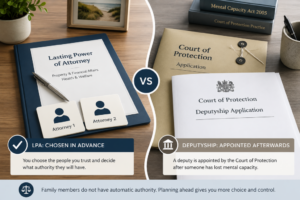
What is the difference between a will and an LPA?
A will operates after death. A Lasting Power of Attorney operates during the donor’s lifetime.
An executor has no authority to manage your affairs while you are alive merely because they are named in your will.
There are two types of LPA:
Making a will and making LPAs address different parts of a complete plan.
Should couples make one joint will?
Each person makes their own individual will.
Couples often make mirror wills containing similar terms, but they remain separate documents. Either person may generally change their will while they have capacity.
Mirror wills can be suitable in straightforward circumstances, but they may not provide enough protection or flexibility for blended families, unequal assets, business interests or complex wishes.
Read our guide to mirror wills for couples.
Can you make your own will?
It is possible to prepare your own will, but mistakes may only become apparent after death, when they can no longer be corrected by the person who made it.
Professional guidance is particularly important where:
- you share property with somebody who is not your spouse or civil partner;
- you have a blended family;
- you want to provide for a dependant who needs support;
- you intend to exclude somebody who may expect to inherit;
- you own a business;
- you own overseas assets;
- you have a large or complex estate;
- trusts may be needed;
- capacity could be questioned; or
- there is a risk of family disagreement.
Common will-writing mistakes
Signing incorrectly
A carefully drafted will may still fail if it is not executed correctly.
Using a beneficiary as a witness
The gift to that beneficiary, or to their spouse or civil partner, may fail.
Forgetting substitute beneficiaries
The will should explain what happens if the first choice dies before you.
Assuming the will controls every asset
Joint property, pension benefits and insurance may pass separately.
Using unclear descriptions
Ambiguous names, gifts or property descriptions can lead to disagreement.
Failing to review the will
Marriage, divorce, deaths, new family members and property changes can make an old will unsuitable.
Making handwritten changes
Alterations made after signing can create questions about validity and intention.
Hiding the original
Executors need to know where the signed original is stored.
Looking only at the will
A will should be considered alongside property ownership, nominations, LPAs and wider estate planning.
A practical will-making checklist
- List your main assets, debts, pensions and policies.
- Check how your home and joint assets are owned.
- Choose executors and replacement executors.
- Decide who should inherit.
- Choose substitute beneficiaries.
- Consider guardians for children under 18.
- Identify any need for trusts.
- Review pension and insurance nominations.
- Consider business, overseas and digital assets.
- Discuss complex tax or financial matters with suitable advisers.
- Sign the will using the correct witnessing process.
- Store the original securely and tell your executors where it is.
- Review the will regularly and after major life changes.
How the Brooks Wills process works
Brooks Wills provides a clear, personal process for individuals, couples and families across Poole, Bournemouth, Christchurch and wider Dorset.
1. Initial discussion
We learn about your family, assets, priorities and existing arrangements.
2. Explain the options
We explain the relevant choices in plain English, including executors, beneficiaries, guardians, substitute gifts and trusts where appropriate.
3. Prepare the will
Your will is prepared to reflect the agreed instructions and circumstances.
4. Review and signing
You have the opportunity to check the document, ask questions and complete the signing process correctly.
5. Keep the plan under review
We encourage regular reviews as family, property and personal circumstances change.
Will-writing guidance in Poole, Bournemouth and Christchurch
Brooks Wills helps people across Poole, Bournemouth, Christchurch, wider Dorset and West Hampshire put clear and practical wills in place.
We explain each step calmly and in plain English, helping you understand your choices and what happens next.
Brooks Wills is a member of the Institute of Professional Willwriters and the Society of Will Writers.
Learn more about our professional will-writing service.
Call, message or book a consultation to discuss making or reviewing your will.
Simplifying legacies, securing tomorrow.
This article provides general information for England and Wales. It is not legal, tax or financial advice. The appropriate will and wider arrangements depend on individual circumstances.
Frequently asked questions
What are the basic requirements for a valid will?
The person must generally be 18 or over, have the required mental capacity, intend the document to operate as their will and sign it using the correct two-witness process.
Can a beneficiary be an executor?
Yes. It is common for an executor also to be a beneficiary. However, a beneficiary should not witness the will because their gift may fail.
Does marriage cancel a will?
Marriage or civil partnership will usually revoke an existing will unless it was made in contemplation of that specific marriage or civil partnership using appropriate wording.
Does divorce cancel a will?
Divorce does not normally revoke the whole will. The former spouse is generally treated as having died before the person who made it for relevant gifts and appointments, which can significantly change the outcome.
How often should I review my will?
Reviewing every three to five years is a useful general approach. Review sooner after marriage, separation, divorce, retirement, a birth or death, a property change or another significant change in circumstances.
Where should I keep my will?
Keep the original securely where it will not be lost, damaged or altered. Tell your executors or another trusted person where it is stored and how it can be accessed after your death.